Where Next?: Exploring Opportunity Areas and Tool Functions for Sustainable Product Design
Abstract
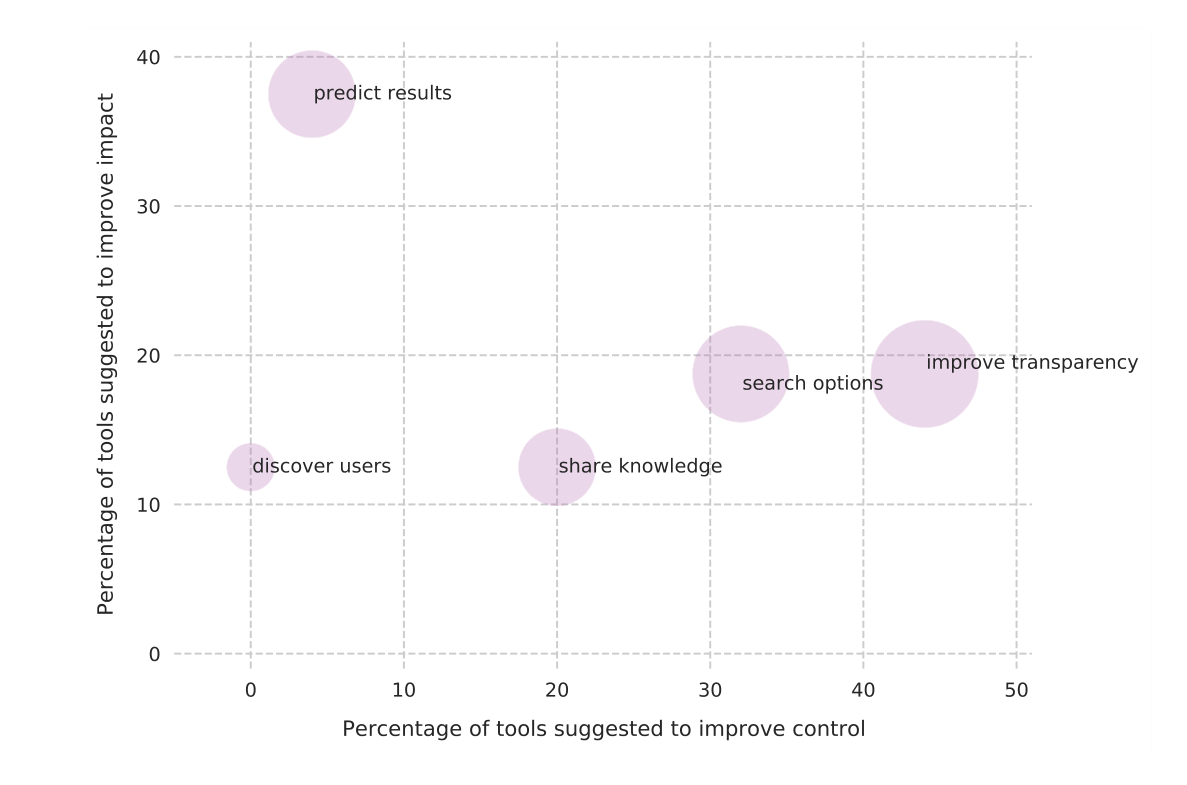
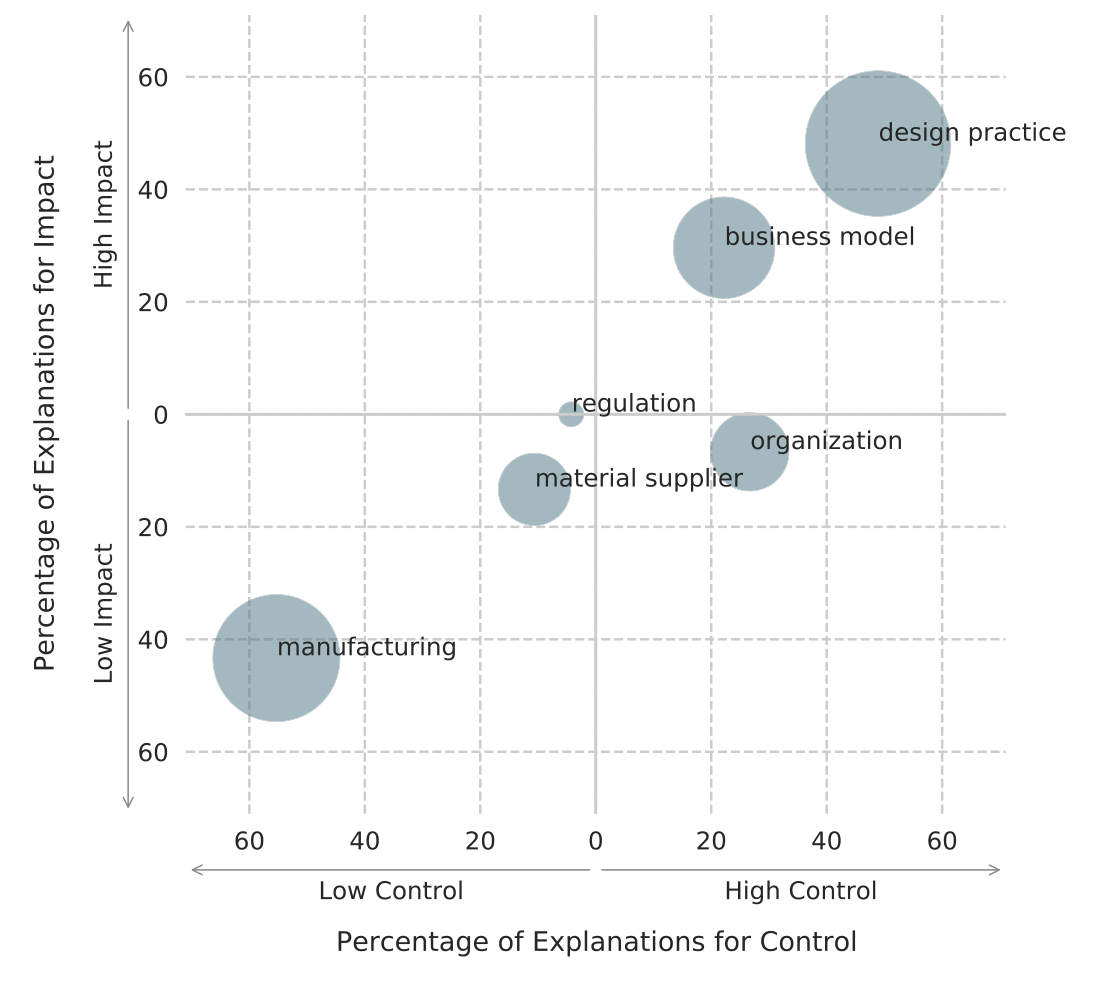
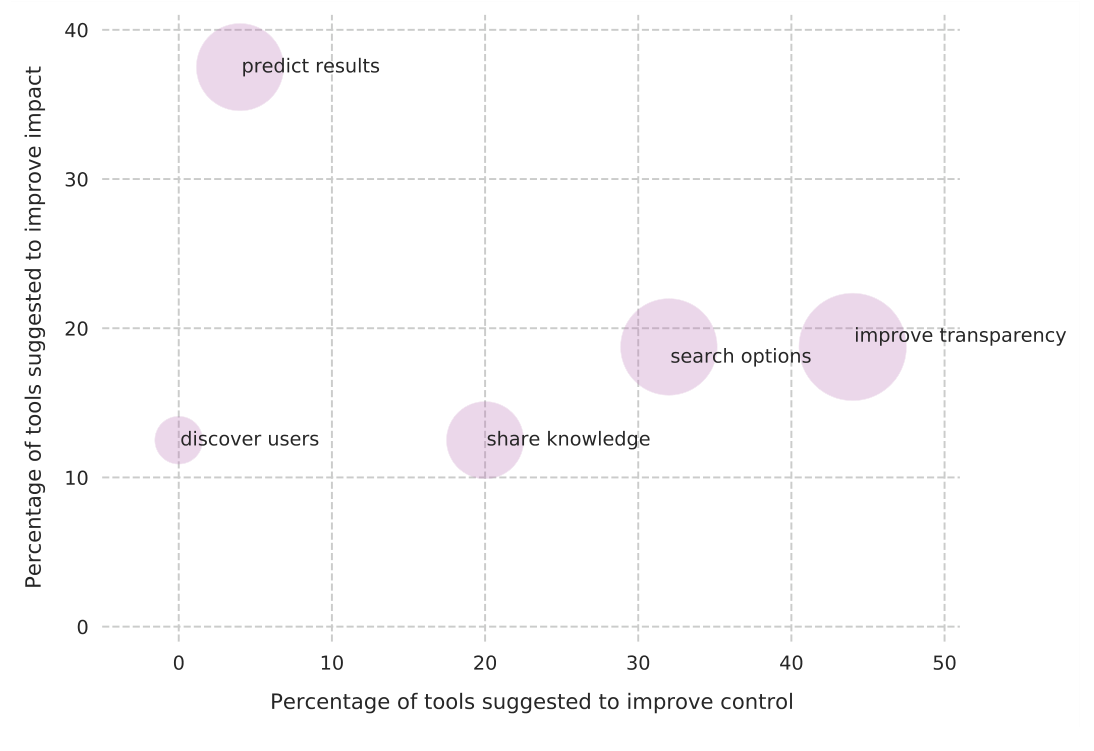
Shifts in policy and consumers’ awareness have raised the importance of sustainability in product design, inspiring the development of tools that support more sustainable design. However, such tools are not adopted as quickly as expected. To understand what tools designers consider useful, we explored how much control designers perceive over existing design strategies, and how much impact they think these strategies have. We used a survey (n = 42) and follow-up interviews (n = 12) to ask hardware product design professionals what areas they see opportunities in, and what functions they look for in tools. The findings reveal that designers perceive impact and control differently in different opportunity areas, so to increase the likelihood of adoption, tools should incorporate features that reflect those differences. Designers report the least control over aspects related to manufacturing, and also rate these as having low impact on sustainability. In contrast, designers attribute high control and impact to aspects related to their design practice and their organizations’ business model, which are tightly linked. To address these issues, designers pointed towards tools that improve information transparency, support decision-making, predict results, share knowledge, and discover user needs. Regardless of how much control designers have, they care about tools and strategies that are highly impactful.
Figures
BibTeX
@proceedings{10.1115/DETC2022-89638,
    author = {Damen, Nicole B. and Wang, Ye and Matejka, Justin and Toh, Christine},
    title = {Where Next?: Exploring Opportunity Areas and Tool Functions for Sustainable Product Design},
    volume = {Volume 6: 34th International Conference on Design Theory and Methodology (DTM)},
    series = {International Design Engineering Technical Conferences and Computers and Information in Engineering Conference},
    pages = {V006T06A007},
    year = {2022},
    month = {08},
    abstract = {Shifts in policy and consumers’ awareness have raised the importance of sustainability in product design, inspiring the development of tools that support more sustainable design. However, such tools are not adopted as quickly as expected. To understand what tools designers consider useful, we explored how much control designers perceive over existing design strategies, and how much impact they think these strategies have. We used a survey (n = 42) and follow-up interviews (n = 12) to ask hardware product design professionals what areas they see opportunities in, and what functions they look for in tools. The findings reveal that designers perceive impact and control differently in different opportunity areas, so to increase the likelihood of adoption, tools should incorporate features that reflect those differences. Designers report the least control over aspects related to manufacturing, and also rate these as having low impact on sustainability. In contrast, designers attribute high control and impact to aspects related to their design practice and their organizations’ business model, which are tightly linked. To address these issues, designers pointed towards tools that improve information transparency, support decision-making, predict results, share knowledge, and discover user needs. Regardless of how much control designers have, they care about tools and strategies that are highly impactful.},
    doi = {10.1115/DETC2022-89638},
    url = {https://doi.org/10.1115/DETC2022-89638},
    eprint = {https://asmedigitalcollection.asme.org/IDETC-CIE/proceedings-pdf/IDETC-CIE2022/86267/V006T06A007/6943412/v006t06a007-detc2022-89638.pdf},
}